Skip to content


Table of Contents
Seeing new hair growth during the first few months of treatment can be encouraging. However, it is also common for progress to become less noticeable after the initial improvement. This does not necessarily mean that a hair regrowth treatment has stopped working.
Hair grows in cycles, and the response to treatment depends on factors such as the growth stage of individual follicles, the underlying cause of hair loss, consistency of treatment, and overall scalp health. As a result, hair regrowth rarely follows a straight upward trajectory. Periods of visible improvement may be followed by slower changes or apparent plateaus.
Understanding why this happens can help prevent people from abandoning treatment prematurely and make it easier to identify when a treatment plan genuinely needs to be reassessed.
Why Does Hair Regrowth Appear Faster at First?
Early changes can sometimes appear more noticeable because several improvements may occur together. Reduced shedding, improved hair quality, and the emergence of new growth can make the scalp appear fuller within a relatively short period.
However, visible improvement does not necessarily continue at the same pace indefinitely. Hair follicles respond over different timeframes, and newly growing hairs need time to develop sufficient length and thickness to become visibly noticeable.
This means that a slower rate of visible improvement after the initial months does not automatically indicate treatment failure.
Understanding the Hair Growth Cycle
Hair does not grow continuously at the same rate. Each follicle moves through different stages of the hair growth cycle.
Anagen: The Growth Phase
During anagen, the hair follicle actively produces a hair shaft. This phase can last for several years, although its duration varies between individuals and different areas of the scalp.
Many hair regrowth approaches are intended to support follicles during this active growth stage.
Telogen: The Resting Phase
During telogen, the follicle enters a resting period before the existing hair is eventually shed and the cycle begins again.
Because follicles are not all in the same phase simultaneously, treatment cannot produce new visible growth from every follicle at the same time.
This is one reason why hair regrowth therapy works in cycles rather than producing a continuous, linear increase in density.
Why Can Hair Regrowth Plateau?
A plateau can have several explanations. Sometimes it represents a normal slowing of visible progress. In other cases, it may indicate that the underlying cause of hair loss has not been adequately addressed or that the treatment protocol needs adjustment.
Inconsistent Treatment or Medication Use
Hair regrowth treatments often require consistency over an extended period. Irregular use of topical treatments, frequently missed applications, or stopping and restarting treatment can interfere with the overall treatment course.
For example, individuals using minoxidil for hair regrowth may need consistent use according to their prescribed or recommended regimen. Changes in use should be discussed with the treating professional rather than made independently.
Missed PRP or Scalp Therapy Sessions
Regenerative approaches such as PRP for hair regrowth are generally delivered as a planned series rather than as isolated procedures.
Missing sessions or discontinuing a recommended treatment programme may affect the overall response. If progress appears to plateau, the treatment schedule and response should be reviewed rather than automatically assuming that another therapy is required.
Hormonal Factors
Hormonal changes can influence hair shedding and follicular activity. Conditions associated with hormonal imbalance may continue affecting hair growth even while a patient is receiving treatment.
If hair loss persists or begins increasing again, a dermatologist or aesthetic doctor may consider whether hormonal factors could be contributing to the change.
Nutritional Factors
Adequate nutrition supports normal hair growth, and certain nutritional deficiencies can contribute to shedding or poor hair quality.
If clinically indicated, nutritional status may therefore form part of the assessment when hair regrowth slows or hair thinning continues despite treatment.
Is a Hair Regrowth Plateau Normal?
Not every plateau means something is wrong.
Hair growth is naturally slow, and changes in density can become increasingly difficult to notice as treatment progresses. A patient may initially see a clear reduction in shedding or visible new growth, followed by a period where changes are subtle.
A plateau may be considered part of the expected treatment course when:
- Hair shedding remains controlled
- Existing hair density is being maintained
- There is no obvious progression of thinning
- The scalp remains healthy
- Treatment is being followed consistently
However, a reassessment becomes more important when there is continued shedding, progressive thinning, new areas of hair loss, or a noticeable decline after previous improvement.
When Does a Plateau Mean the Treatment Needs Adjusting?
A change in treatment may be appropriate when the original approach is no longer producing the expected response or when a new contributing factor has emerged.
A dermatologist or doctor may review:
- Changes in hair density
- Pattern and extent of hair loss
- Scalp condition
- Treatment adherence
- Current medications
- Hormonal factors
- Nutritional status
- Previous treatment response
Rather than simply increasing treatment intensity, the objective is to understand why progress has slowed and determine whether the underlying approach needs to change.
What Does a Doctor-Led Reassessment Involve?
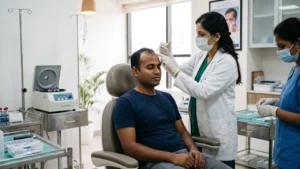
A reassessment begins with reviewing the patient’s progress since treatment started. This may include comparing changes in hair density, shedding, scalp condition, and the distribution of thinning over time.
Scalp and Hair Assessment
The dermatologist or doctor may examine:
- Hair density
- Hair shaft thickness
- Scalp condition
- Distribution of thinning
- Signs of inflammation or other scalp conditions
Depending on the case, photographic documentation or scalp imaging may also help track changes more objectively.
Blood Tests When Clinically Indicated
Blood investigations are not automatically required for every person experiencing hair loss. However, when the clinical history suggests a possible hormonal, nutritional, or systemic contributor, appropriate tests may be recommended.
The specific investigations depend on the individual’s symptoms, medical history, and examination findings.
Revising the Treatment Combination
Based on the reassessment, the treatment plan may be continued, modified, or combined with another appropriate approach.
Depending on the diagnosis, this may involve medical treatment, topical therapy, PRP, scalp-focused procedures, nutritional correction, or a combination of approaches.
Realistic Expectations for Hair Regrowth
One of the biggest challenges in hair restoration is expecting visible changes to occur at the same pace throughout treatment.
Hair follicles need time to move through their natural growth cycle, and newly emerging hairs initially tend to be fine and less visible. Improvements in hair density can therefore take considerably longer to become obvious than reductions in shedding.
A realistic treatment timeline means understanding that:
- Early improvements may be easier to notice
- Progress can slow as treatment continues
- Hair density changes gradually
- Consistency is important
- Treatment may need adjustment as the scalp responds
- Long-term maintenance may be necessary for some causes of hair loss
Understanding these timelines can prevent patients from abandoning an effective treatment simply because the rate of visible improvement has slowed.
How Isya Aesthetics Approaches Slowing Hair Regrowth
At Isya Aesthetics, a slowing response is approached as a reason to reassess rather than automatically increase treatment.
A scalp consultation can evaluate the current pattern of hair loss, changes in density, scalp health, treatment consistency, and possible contributing factors. Where clinically appropriate, the treatment plan may then be adjusted according to the individual’s response and underlying diagnosis.
The objective is to distinguish between a normal slowing of visible progress and a genuine treatment plateau that requires a change in strategy.
For individuals seeking Hair Regrowth Treatment in Vasant Vihar, New Delhi, a doctor-led assessment can help determine whether the current treatment remains appropriate or whether additional evaluation is needed.
Frequently Asked Questions
Why does hair regrowth slow down after a few months?
Hair follicles grow at different rates and move through different stages of the growth cycle. Early improvements may be more visible, while later changes can become slower and less noticeable. A plateau can also occur if treatment is inconsistent or an underlying factor continues to affect hair growth.
How long does hair regrowth treatment take to show results?
The timeline varies according to the cause and severity of hair loss and the treatment being used. Hair growth is gradual, so meaningful changes in density generally require several months rather than a few weeks.
Can hair regrowth treatments stop working?
A treatment may appear to plateau, but this does not necessarily mean it has stopped working. The underlying cause, treatment consistency, hair cycle, and scalp health should be evaluated before deciding whether the treatment needs to change.
Does minoxidil help with hair regrowth?
Minoxidil is used for certain forms of hair loss and may help support hair growth in appropriate patients. Its effectiveness depends on the underlying diagnosis and consistent use according to professional guidance.
Can PRP help with hair regrowth?
PRP is used as a hair restoration therapy in selected patients. Whether it is appropriate depends on the type and cause of hair loss, and treatment is generally planned as a series rather than a single session.
Can nutritional deficiencies slow hair growth?
Certain nutritional deficiencies can contribute to hair shedding or impaired hair quality. If a deficiency is suspected based on a clinical assessment, appropriate testing and nutritional correction may form part of the overall management plan.
Can hormones affect hair regrowth?
Yes. Hormonal factors can influence the hair growth cycle and contribute to continued thinning or shedding. When clinically indicated, a dermatologist may investigate possible hormonal contributors.
Should I stop treatment if my hair regrowth has plateaued?
Not without discussing it with your treating professional. A plateau may be a normal part of the treatment timeline, while in other cases the treatment plan may need adjustment. Reassessment can help distinguish between the two.
How can I tell if my hair density is actually improving?
Changes in hair density can be difficult to judge from day-to-day observation. Consistent photographs taken under similar lighting and scalp assessments can provide a more reliable way to track progress over time.
Where can I get a hair regrowth consultation in Vasant Vihar, New Delhi?
If your hair growth has slowed or your hair thinning continues despite treatment, a scalp and hair assessment can help identify possible contributing factors and determine whether your current treatment plan should be adjusted.
Conclusion
Hair regrowth rarely happens at a constant pace. Early improvements may be more visible, while later progress can appear slower as follicles move through different stages of the growth cycle and newly growing hairs gradually develop greater length and thickness.
A plateau can sometimes represent a normal stage of treatment, but persistent shedding or progressive thinning may indicate that an underlying factor has not been addressed or that the treatment protocol needs reassessment. Consistent treatment, realistic expectations, and periodic clinical review are therefore important parts of long-term hair management.
If your hair regrowth treatment appears to have slowed, reassessment can help determine whether you are experiencing a normal plateau or whether your treatment strategy needs to change.
Book a scalp consultation at Isya Aesthetics to find out why regrowth has slowed and what treatment adjustment may help you move forward.