Skip to content


Table of Contents
Hair concerns are often described in simple terms like “hair fall” or “hair loss.” However, not all hair issues are the same. Two of the most commonly confused conditions are low hair density vs hair thinning.
Understanding this difference is important because the right diagnosis leads to the right treatment. If you are noticing less volume, visible scalp, or reduced fullness, this guide will help you understand what is actually happening
What Is Low Hair Density?
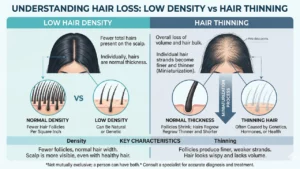
Hair density refers to the number of hair strands present per square inch on the scalp. When this number is naturally low, it is called low hair density.
People with low density may have:
- Fewer hair follicles from the start
- Fine or widely spaced hair strands
- A scalp that is more visible even without hair loss
This means low density is often genetic or natural, not always due to active hair fall.
Key Characteristics of Low Hair Density:
- Hair looks flat even after styling
- Scalp visibility increases in bright light
- Ponytail or braid feels thin
- No sudden increase in hair shedding
This answers the common question: what is low hair density — it is about quantity of hair, not necessarily hair loss.
What Is Hair Thinning?
Hair thinning, on the other hand, is a progressive condition where hair strands become weaker, finer, or start shedding over time.
Unlike low density, this is an active process.
Early Signs of Hair Thinning:
- Increased hair fall while washing or combing
- Reduction in hair volume over time
- Wider parting line
- Hair becoming finer in texture
This is often described as diffuse hair thinning vs low density, where thinning spreads across the scalp rather than being fixed from birth.
Difference Between Hair Thinning and Low Hair Density
Although both conditions lead to reduced hair volume, their causes and progression are different.
Low Hair Density
- Usually genetic
- Stable over time
- No active shedding
- Hair count is naturally lower
Common Causes:
- Genetic hair distribution
- Naturally fine hair
- Aging-related reduction in follicles
- Previous hair loss conditions
Hair Thinning
- Develops over time
- Linked to hair fall or miniaturization
- Can worsen if untreated
- Often related to lifestyle or medical factors
Common Causes of Hair Thinning:
- Hormonal imbalance
- Stress and lifestyle factors
- Nutritional deficiencies
- Scalp conditions
- Post-illness hair fall
Understanding the difference between hair thinning and low hair density helps in choosing the right solution.
Treatments for Hair Thinning and Low Density at Isya Aesthetics
At Isya Aesthetics, treatments focus on improving scalp health, strengthening follicles, and supporting hair growth.
Not every treatment is used for every condition. The approach is customised based on whether you have thinning, low density, or both.
Most regenerative treatments used for hair thinning and low density work by improving blood supply, activating growth pathways, and supporting the hair follicle cycle, which helps increase both hair thickness and density over time. Some advanced therapies also act on cellular signalling pathways such as Wnt and ERK, which are known to regulate hair growth cycles.
1. Polynucleotides (PN Therapy) – Regenerative Scalp Treatment
Polynucleotide therapy is a regenerative treatment that works at the scalp level by improving the environment around hair follicles rather than just stimulating growth.
It is especially useful in:
- Early-stage thinning
- Low density with weak or inactive follicles
- Poor scalp health
How it works:
- Polynucleotides are injected into the scalp
- They improve microcirculation and support repair at a cellular level
- Help reduce inflammation around follicles
- Promote better blood supply, which is essential for hair growth
What it helps with:
- Strengthening existing hair
- Improving scalp quality
- Supporting gradual increase in hair density
This makes it an effective option for both non-surgical hair density treatments and early intervention in thinning cases.
2. PRP and Advanced PRP
PRP (Platelet-Rich Plasma) is one of the most commonly used treatments for hair concerns and works by using your body’s own growth factors to stimulate hair follicles.
How it works:
- A small amount of your blood is processed to concentrate platelets
- This platelet-rich plasma is injected into the scalp
- The growth factors released during PRP also activate key pathways involved in hair follicle regeneration, supporting the shift of hair into the active growth phase.
What it helps with:
- Reduces hair thinning
- Improves hair thickness and density
- Supports regrowth in weakened follicles
- Helps prolong the growth phase (anagen phase), which can improve hair length and quality
Advanced PRP enhances this process with improved concentration and delivery techniques, allowing better response in cases of ongoing thinning.
3. Magick Hair Rescue (Growth Factor Treatment)
For hair growth treatments to work effectively, the scalp must be clean, balanced, and free from buildup.
Magick Hair Rescue prepares the scalp while also supporting growth.
How it works:
- Deep cleansing removes oil, dead skin, and environmental buildup
- Improves scalp hydration and balance
- Infuses growth-supporting factors into the scalp
What it helps with:
- Better absorption of other treatments
- Reduction in dandruff and irritation
- Healthier scalp environment
- Improved support for hair density over time
4. Liquid Gold Therapy
Liquid Gold treatment focuses on improving hair growth by delivering concentrated regenerative signals directly to the scalp. These exosome-based signals are derived from regenerative cell communication processes and help improve how hair follicle cells function and respond to growth signals.
How it works:
- A nutrient-rich solution containing autologous exosomes is introduced into the scalp
- These signals help improve communication between hair follicle cells
- Support follicle repair and protect against further weakening
Best suited for:
- Hair thinning
- Reduced hair density
- Weak or damaged hair follicles
This treatment is often used when the goal is to improve both hair strength and overall density.
Advanced and Emerging Hair Growth Treatments
In some cases, depending on the degree of hair thinning or low density, additional regenerative treatments may be included as part of a customised plan. These treatments work by improving blood flow, supporting follicle function, and activating natural hair growth pathways.
- Botulinum Toxin (Scalp Botox):
Botulinum toxin is used to relax scalp muscles, which can improve blood circulation around hair follicles. Better blood flow helps deliver oxygen and nutrients more effectively, supporting hair growth in certain cases. - Er:Glass ClearSkin Laser (1550 nm Fractional Laser):
This laser uses controlled thermal energy to create micro-level stimulation in the scalp. This triggers a natural repair response, which can improve hair shaft thickness over time. It is often used when the goal is to improve hair quality rather than increase hair count. - Exosome-Based Therapies (Stem Cell-Derived Signals):
These treatments use signals derived from stem cell processes to improve communication between hair follicle cells. They help activate pathways such as Wnt/β-catenin, which are important for hair growth and follicle regeneration.
These treatments are selected based on individual scalp condition and are usually combined with primary therapies for better results.
Which Treatment Is Right for You?
The right treatment depends on whether you have:
- Low hair density
- Active hair thinning
- Or a combination of both
This is why diagnosis is important. A proper assessment helps decide the correct plan instead of trying random solutions.
Conclusion
At Isya Aesthetics, a wide range of scalp treatments for hair thinning and non-surgical hair density treatments are available to improve scalp health, strengthen follicles, and support better hair growth. Located in Vasant Vihar, South Delhi, Isya Dermatology & Aesthetics offers personalised treatment plans under the guidance of experienced doctors. Patients can explore the About Us and Dermatology Team sections on the website to understand the clinic’s approach, expertise, and treatment philosophy before starting their hair restoration plan.
Not sure whether you’re dealing with hair thinning or low hair density? Book a personalized consultation today to get an accurate diagnosis and explore advanced treatments like regenerative scalp therapies designed to restore fuller, healthier-looking hair.
FAQs
What is the difference between hair thinning and low hair density?
Hair thinning is a gradual reduction in hair volume due to hair fall or weak follicles. Low hair density means fewer hair strands naturally present on the scalp.
Can low hair density be increased?
While natural density cannot completely change, treatments can improve scalp health and make hair appear fuller.
What are early signs of hair thinning?
Early signs include increased hair fall, wider parting, and reduced volume over time.
Which treatment is best for hair thinning?
Treatments like PRP, polynucleotide therapy, and scalp treatments are commonly used to manage hair thinning.
Can hair density improve naturally?
Lifestyle changes can help, but clinical treatments provide more visible and faster results.
Is hair thinning reversible?
In early stages, hair thinning can be managed and improved with the right treatment and care